Hello, everyone!
I've been wanting to write this post for ages. Well, the wait is finally over, and the years of hard work have finally paid off. Rosenkreuzstilette -Blades of the Rose Cross- has now made its official English language debut!
It's been a little over eight years since Alex / TrickMasterMint and I first met on this very blog. That first encounter has had an enormous impact on my life these past few years. Sure, we butted heads often, but we remained fast friends. I'd like to think that our work is all the better for it. Seriously, man, I couldn't have done this without you. If you're ever in the Montreal area, I need to buy you a drink. It's, like, a law or something...
Anyway! You can buy a copy of Rosenkreuzstilette from either Playism or Steam for $9.99 USD (with a 10% discount if you grab your copy within the next week). Like I said in my previous post, I highly recommend going through Playism since that route nets you a free Steam key.
On a related note, I'm sure many of you have chanced upon a YouTuber by the name of Hadriex and his cheeky-but-fair review of Rosenkreuzstilette. Well, he reached out to us and offered to make us a special trailer to commemorate the game's official release.
What do you think?
Be sure to leave your comments on Hadriex's trailer and our revised localization below. And, of course, have fun!

Showing posts with label Rosenkreuzstilette. Show all posts
Showing posts with label Rosenkreuzstilette. Show all posts
Friday, February 3, 2017

Thursday, January 26, 2017
Let the Countdown Begin!
The time has finally come.
After years of hard work, I'm proud to announce the official English release date of Rosenkreuzstilette! Guess what? It's next week!
Don't take my word for it, though. Here's the official trailer:
You can preorder the game from Steam or Playism. I recommend going through Playism; it comes with a free Steam key.
The curtain has risen; who can say what has yet to unfold?
After years of hard work, I'm proud to announce the official English release date of Rosenkreuzstilette! Guess what? It's next week!
Don't take my word for it, though. Here's the official trailer:
You can preorder the game from Steam or Playism. I recommend going through Playism; it comes with a free Steam key.
The curtain has risen; who can say what has yet to unfold?
Tuesday, January 24, 2017
RKS Developer Diary #14 - Background Info

As promised in my last Dev Diary, this will be the final Developer Diary entry devoted to the original Rosenkreuzstilette. A few aspects of the game's localization have changed since I last shone a spotlight on them in earlier entries, whether because of developer / publisher requests or because we were hit with a sudden burst of inspiration (for instance, "Escargot Kame" / "Snail Tortoise" has been officially renamed "Tortoisnail"). I've gone back and updated the text of earlier Developer Diary entries for the sake of consistency, but I've left the original screenshots intact so that you can compare development screenshots with the final release.
Naturally, some of you may want to update the wiki to make sure the information it contains isn't out-of-date.

Since I'm sure many of these tweaks will go unnoticed, I figure I may as well draw attention to some of the changes we made to the stage backgrounds. If you have an old, low-contrast cathode ray tube (CRT) monitor, the color corrections we made to the tilesets of Luste's and Sichte's levels are practically invisible. On the other hand, if you have a more modern display with an adequate level of contrast (an LCD, OLED, TFT, or plasma screen display), the difference is obvious. As usual, click on the images to get a closer look.
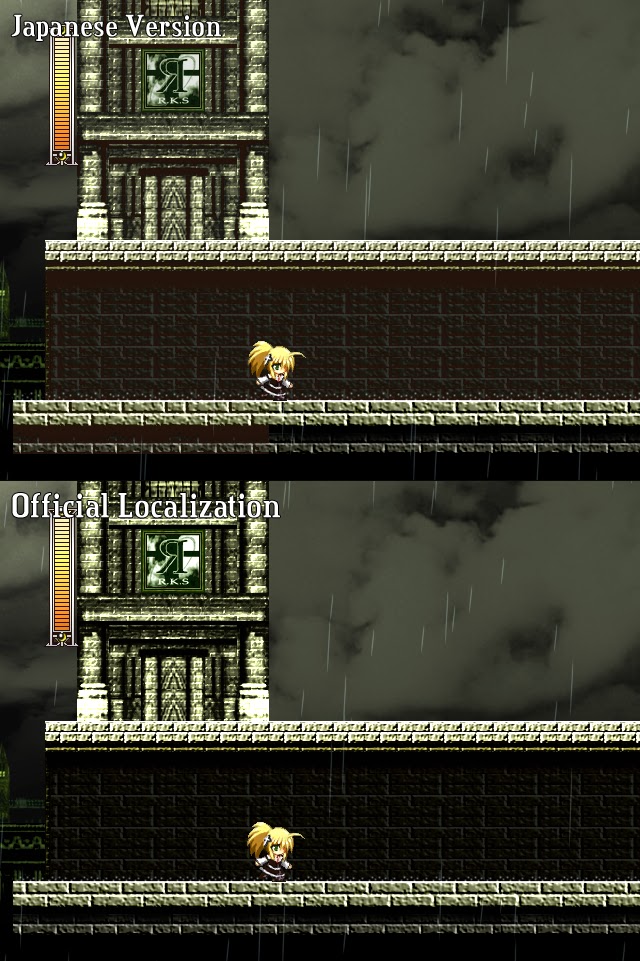
As for the masonry of Zwerberg's clock tower, take a good look at the screenshot to the right. For some reason, the bricks on the left side of the antechamber as well as the rear wall and ceiling are a different color than the rest of the stage. In fact, the entire tileset has a reddish tinge to it that isn't present in any of the background graphics -- something that really stands out when the tiles are placed side-by-side (like the area just below Tia's feet). We addressed the issue in the same manner as we did with Luste's stage, using a color dodge layer to remove the excess red and ensure that the color scheme was consistent.

For our official release, we decided to instead warn players about the contents of the canisters and update the sign to match something you'd find in an actual factory. So, with that kind of setting in mind, the choice was obvious. "Warnung: Hazardous Materials". We doubt that the new sign will prevent newcomers from getting smacked in the face by an overzealous portable suitcase, but at least they'll be able to laugh at themselves when they read the sign and realize what might have been in the tank.
Last, but not least, we have the background of the teleporter room in Iris Stage III. The rear wall sports the mirror image of a sinister message (with some random gibberish thrown in for some reason). In the official English version, we cleaned up the Engrish and formatted the text to give astute players a subtle hint regarding what lay ahead:

Eins, Zwei, Drei...
Rosenkreuzstilette...
God knows
her death
is drawing near...
Hide your fear...
Death
sleeps in
Heaven Hell
Delight Love
Joy Spite
Despair Sorrow
Foresight Anger
Dry her tears
with blood...
You can stop
screaming now...
Rosenkreuzstilette...
God knows
her death
is drawing near...
Hide your fear...
Death
sleeps in
Heaven Hell
Delight Love
Joy Spite
Despair Sorrow
Foresight Anger
Dry her tears
with blood...
You can stop
screaming now...
As you can tell from the screenshots, the text was formatted a bit differently in the original Japanese version. In both versions, the final lines are hidden by the teleporters leading to the Zorne and Sichte homunculi.
Look closely at the positions of each of the emotions in the second paragraph. Where have we seen these words before...? Are they alluding to something...? Hmmm...
Well, that's enough out of me for now. Thank you for following along with the Rosenkreuzstilette Development Diary. The next time we meet, it should be for the debut of the Rosenkreuzstilette Freudenstachel Development Diary. Since the actual game is complete (my only remaining tasks involve the manual and the installer), feel free to request in the comments what you'd like me to explore with you first. Unless it's something I'd consider a spoiler, I'll be happy to oblige.
Oh, one more thing. I'm not sure how accurate this thing is, but if it's spot-on, I'd be very much looking forward to next week if I were you:

Tuesday, September 13, 2016
RKS Developer Diary #13 - Game Over, man!
 |
| Murder on the Mississippi (Commodore 64) |
By now, it's no big surprise that my personal life gets pretty hectic at times. Sometimes, it's for the worse (my godmother / great aunt recently passed away, one of my roommates needed to move out because of financial problems, and my schedule at my day job has me working more hours than before). Sometimes, though, it's for the better (part of my schedule change is because I'm responsible for training a new hire, who -- lucky me! -- is an absolute beauty and a joy to work with). Still, I continue my work on Rosenkreuzstilette during my off-hours, and my days off allow me to focus and make much quicker progress than the days where I'm forced to juggle my duties. Playism, WOMI, and Valve are doing their part in preparing RKS for its Steam debut, so my current circumstances thankfully don't have any impact on the original game's official release.
Onto today's developer diary!
I've just completed the Game Over screens for Rosenkreuzstilette Freudenstachel, making this the perfect time to post about the Game Over screens for both games. I don't want to spoil the surprises in the sequel just yet, so I'll be concentrating on the Game Over references in the original game for the time being.
Without further ado:
Prologue: Murder on the Mississippi
A chronicle of the adventures of Sir Charles Foxworth, Murder on the Mississippi was only released on the MSX2 and the original Famicom in Japan. In the English-speaking world, the game was only released on the Commodore 64, the Commodore 128, and the Apple II. In this reference, Lilli plays the part of Sir Foxworth's faithful assistant Regis, mourning Spiritia's untimely death with Regis's signature "if only we could start over, we might be able to catch that villain...". I made a point of using the iconic font from the original Commodore 64 version to further reinforce the reference for truly old-school players.
 |
| Racing Lagoon (PlayStation) |
It feels like only yesterday that Squaresoft was experimenting with every game genre under the sun. Dubbed a "High Speed Driving RPG" by Square, Racing Lagoon was a racing game for the original PlayStation that never saw a release outside of Japan. The brushwork capital "R" in this reference is an undeniable nod to the game's cover art and title screen.
As I'm pleased to see many of you notice, I pay very close attention to detail in my work; I make a point of using the original fonts in each of the RKS references where I can. This practice applies not just to the Game Over homages, but to all of the graphics in the series.
Zorne Stage: Super Bomberman Series
In the early '90s, if you had a Super Nintendo, a Super Multitap, a few extra controllers and a copy of Super Bomberman or Super Bomberman 2, you could easily turn a get-together into a gaming party that lasted all night. It's a shame that only the first two Super Famicom titles were ever released in North America; the games were extremely fun, to say the very least.
Since this Game Over reference didn't contain any English text, no changes needed to be made for the game's official English release.
Trauare Stage: Demon's Crest / Gargoyle's Quest
The winged demon in this Game Over reference is clear nod to the title screen of Demon's Crest for the Super Nintendo (released as Demon's Blazon in Japan). The incantation, on the other hand, is a nod to Gargoyle's Quest for the original Game Boy. Both games are entries in the Firebrand trilogy, a series of spinoffs set in Capcom's Ghosts 'n Goblins / Ghouls 'n Ghosts universe.
Although I was quite proud of the cleanup work I did for the fan-translated version of this reference, nothing quite beats having the original Photoshop files to work with. I experimented with using the original Ghosts 'n Goblins series font for the English version, but the font was too big and weighty to look presentable. Instead, I opted to use a thinner, lighter font that preserved the feel of the original Japanese version and didn't make the composition heavier than it needed to be.
Luste Stage: The Embodiment of Scarlet Devil / S.T.U.N. Runner
Ah, Touhou Project: the sleeper hit that launched the Japanese indie game craze in addition to creating its own genre of shoot 'em ups. The sight gag here is pretty self-explanatory to Touhou fans, recreating the cover art for The Embodiment of Scarlet Devil with Luste taking the place of Flandre Scarlet. Although WOMI claims that the "Insert Coin" text is intended as a reference to S.T.U.N. Runner, I think the text is just a bit too generic to credit to any particular arcade game. Oh, well...
Unlike the rest of the graphics in the game, this particular reference was drawn by Isemiya instead of WOMI. Although I don't know the circumstances of their breakup (nor do I intend to ask), I can safely say that WOMI no longer possesses the original source files for this reference. That being the case, I fine-tuned the version from our fan translation for use in the official release instead of rebuilding the graphic with officially reconstructed materials. I'm particularly proud of how this one turned out; all of the German and Japanese text is translated and typeset specifically to match the appearance of the Scarlet Devil cover art. I can safely say that this graphic would look very different if Touhou was given an official physical English release.
 |
| Final Fantasy Legend II (Game Boy) |
Known as SaGa 2 in Japan, I remember borrowing this Game Boy title from a friend of mine back when I was in high school (I don't think I ever finished it, though...). This was one of the few Game Over references that I decided to completely rebuild from scratch instead of cleaning up the original Japanese graphics and inserting the English translations. I'm quite pleased with how it turned out. For the official release, I decided to expand the reference a bit to further underscore the shout-out and make it more faithful to the source material.
If you're interested, the Nintendo DS remakes of Final Fantasy Legend II and III have been fan-translated into English under the names SaGa 2: Legend of the Relics -Goddesses of Destiny- and SaGa 3: Champions of Time and Space -Shadow or Light- (what a mouthful). To the looks of it, they're of the same caliber as the 3D Final Fantasy IV remake. Good stuff.
Sichte Stage: Jojo's Bizarre Adventure
Although I'm not a fan of the Jojo series myself , I have to admit that I enjoyed searching through digital copies of Viz's manga release to pinpoint the exact panel being referenced by this sight gag. I'm already quite proud of the English rendition I created for our fan translation (rebuilt from scratch, no less). Even so, the revised version just feels right on so many levels. I'm kind of amused that Spiritia takes the place of Terrence T. d'Arby, a.k.a. "d'Arby the Player". In both cases, the player loses the game.
Liebea Stage: The Tower of Druaga
Amusingly enough, my introduction to The Tower of Druaga was its 2008 anime adaptation, The Aegis of Uruk, which lampooned the original arcade game for its obtuse design and frustrating level of difficulty. I can easily understand why the title is so infamous among old-school gamers. Like the Super Bomberman reference, this reference contains no text, so no changes were needed to prepare its official English version.
Schwer-Muta Stage: Space Invaders
This arcade classic has since become the face of Tommy Tallarico's Video Games Live tour. Though the game never really appealed to me, I can't deny its impact on the medium. For the fan-translated version of this reference, I decided to rebuild the graphic from scratch to correct a minor oversight: the 30-point alien sprite contained two blocks that weren't supposed to be there. When WOMI passed me his source files of the official release, I made a point of deleting those same blocks to ensure that the alien sprite was perfectly faithful to the arcade original. If that makes me a hairsplitter, so be it.
 |
| Jojo's Bizarre Adventure (Manga - Viz Media) |
Known as Actraiser in Japan (no, I have no clue why they felt they needed to change the capitalization), this Super Nintendo platformer / God-game hybrid was one of the many games I would have passed over if not for the likes of amateur YouTube reviews like Joey DeSena's 16-Bit Gems. Since the game had an official English release, localizing the Japanese text with an appropriate font was a piece of cake.
In ActRaiser, the player is referred to as "The Master" or "Sir
Zeppelin Stage II: Dragon's Lair
A nod to the NES adaptation of the game rather than the original arcade game. The Engrish typo in "Closs" in the original reference always bugged me, and I made a point of correcting the typo in our fan translation. When WOMI provided us with the original layers for this graphic, a sudden burst of inspiration prompted me to rebuild the interface portion of the graphic. Looking back, I think the Extra Life and Cross Tank icons are just a bit too big, but other than that, I'm satisfied with the results. I'll probably correct the issue in a post-release update, so there's nothing to worry about.
Zeppelin Stage III: Shadowgate
Like Murder on the Mississippi, Shadowgate is a point-and-click adventure game originally made for Western computers that was later ported to Japanese consoles. The game was considered quite a success, spawning several sequels and even a Kickstarter-funded remake. If you've played the visual novel parody Hatoful Boyfriend, you may recognize the title's Bad Ending screen as a bird-themed take on Shadowgate's Game Over screen.
Rosenkreuzstilette's nod to Shadowgate is very true to the original, casting Thanatos Seyfarth in the role of the Grim Reaper. Observant players may notice how the reference subtly lends you a hand in defeating Thanatos, featuring which weapons are most effective against the wraith in the player's inventory. For the English versions, I rebuild the graphics from scratch yet again (as you've likely figured out by now, I enjoy doing this for 8-bit and 16-bit titles). For the official version, I've expanded that list of "Goods" to include all of the weapons effective against Seyfarth (in the off-chance that your Mana supply for his two primary weaknesses is exhausted).
 |
| Zoo Ball (Super Famicom) |
Here, RKS pays tribute to one of the hardest video game series of all time, Ninja Gaiden, with Nightwalker Zeppelin assuming the role of protaognist Ryu Hayabusa before his climactic battle with Jaquio. It's interesting to note that, from Zeppelin's point of view, his actions are entirely justified (not unlike the General in Megaman X4). But I digress...
I was on the fence about whether I should localize this reference in the style of the NES original or the Super Nintendo remake; in the end, I decided to stick with the original. WOMI is smacking himself upside the head over the fact that, if a player is going through the game for the first time and loses all of their lives before reaching the Zeppelin, this reference technically spoils what should be a mid-battle twist. Oh, well -- those of us familiar with Castlevania saw that twist coming anyway...
Iris Stage I: Zoo Ball
Known as Dolucky no Kusayakiu (Dolucky's Baseball Turf) in Japan, this Coca-Cola-sponsored anthropomorphic baseball title was going to be released in English under the name Zoo Ball. Unfortunately, this never came to pass; the game was unceremoniously cancelled for reasons unknown. That's a shame; though I'm not a fan of sports games, I did enjoy my time with the Japanese version of Zoo Ball.
This particular Game Over reference is a nod to the game's training mode. If your training goes badly and you fail that session's objectives, Dolucky's coach will make a lighthearted jab at you before encouraging you to give it your best shot next time. For the official English version, I retooled his dialogue to sound more like what a good coach would actually say in real life.
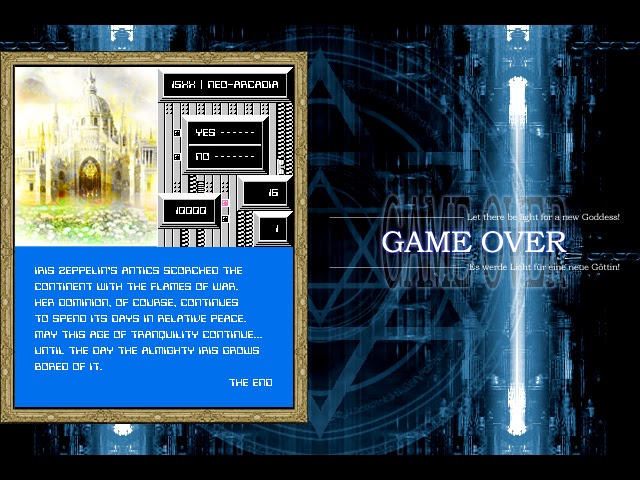
Iris Stage II: The Legend of Zelda - Link's Awakening (DX)
Sitting majestically atop Mount Tamaranch, the Wind Fish's Egg is the reason behind the English name of the level's boss, the Deviled Egg. Interestingly, this reference is a nod to both incarnations of the Game Boy's first The Legend of Zelda title. The monochrome palette is a definite callback to the original Game Boy release, while the clouds around the mountain's peak are only found in the Game Boy Color re-release, Link's Awakening DX.
Naturally, nothing special needs to be done to this reference for the English release.
 |
| Time Stranger (Famicom) |
The video game adaptation of Studio Madhouse's 1986 animated feature, Time Stranger was only released on the Japanese Famicom by Kecmo (the same developer behind the NES version of Shadowgate). Though no English versions of the film or game were released prior to our original fan translation, I'm pleased to report that several fansub groups have released English translations of the film since that time.
Of all of the localized graphics in our fan translation, the English version of the Time Stranger reference was the one that I was least satisfied with. I'm very happy to say that, for the official release, this one deserves to be recognized as the Biggest Improvement. If there's anything I'm not satisfied about with the final version, it's that the variable-width retro-look font I used doesn't lend itself well to maintaining a tidy right margin. This is a rare instance in which I would have preferred a fixed-width font.
Final Stage: Megaman Zero 2
It just wouldn't be right if a Megaman-style game didn't make at least one of its shout-outs a nod to the Blue Bomber or one of his many spinoffs. Like the Shadowgate reference, this Game Over homage offers a subtle hint regarding how to take care of Iris (provided you chanced upon the secret treasure of the Black Forest earlier in the game, of course). Again, I opted to rebuild the graphic from scratch for the English version, and I'm quite pleased with how it turned out.
Aside from these seventeen references, I may or may not have hidden additional references in the game's code. I cannot elaborate on what I did or where to find them -- it'd spoil the surprise to talk about it before the game's even out.
The next entry will be the last entry focused on the original Rosenkreuzstilette. After that, the blog will move onto covering Freudenstachel material. Is there anything you'd like to know about the original game before it finally hits Steam and Playism? If so, leave a comment below and I'll try to include the answers you're looking for in the final installment of the RKS Developer Diary.
See you then!
Monday, August 1, 2016
RKS Developer Diary #12 - Your new name is "Mid-Boss".
Hi, everybody!
Things have been pretty hectic on our side of the pond lately. Our work on the original Rosenkreuzstilette is more or less done. Now that we finally have our hands on the sequel's source code, we've finally begun working on Freudenstachel in earnest.
As you may have noticed, a good chunk of the responsibilities for RKS fell squarely on my shoulders. I penned the final version of the English script, localized the graphics, reprogrammed the game engine to properly support English text and optional subtitles, you get the idea. It wasn't a one-man show by any means, but I did assume a disproportionate amount of the work. And the result of that thoughtless decision? Whenever anything happened that prevented me from working on the game for any reason (illness, hardware failure, problems at my day job, family emergency, and so on), our forward progress was halted until the matter was taken care of and I was able to work on the game again. I became what we refer to within the industry as a "bottleneck". As you can imagine, a few members of the project staff were less than satisfied with this state of affairs, and with damned good reason.
Moving forward with Freudenstachel, I'll be reprising my role as the resident graphics editor and programmer, but I'll be leaving the polishing of the script in the hands of my good friend Xander (who also handled the casting and directing for the English voiceovers until we were asked to put the English voice project on hold). TrickMasterMint and DekuKirby are reprising their roles as well; we've simply reorganized ourselves to remove any bottlenecks and optimize our manpower. You can rest assured that it's still the same team working on the English version of Rosenkreuzstilette Freudenstachel, so please continue looking forward to our finished release.
Onto today's developer diary!
This time around, we'll be having a look at the major enemies in the game that block your forward progress, but aren't quite on the same level as the bosses we shone a spotlight on last time. Like pretty much every other enemy in the game, Isemiya named each mid-boss in his commented code. Some of the names he chose are appropriate, while others have understandably been retconned by the sequel:
Trauare Stage
Japanese: 「大王イカ」
English: "Great Hydra"
The "Great Squid" in Japanese, we have two objections to preserving this name as the official English moniker. You probably didn't expect a company named "Darksquid Media" to veto a squid reference, huh? Well, for starters, this boss doesn't look like a squid at all; it's more of a many-headed sea serpent. Second, I'm sure you can agree that there's only one character worthy of the title of the "Great Squid" in the RKS series - and his name is Zeppy.
On that note, if you'll excuse a quick tangent: a few fans have speculated that Zeppy may be a reference to "sepia", the German word for cuttlefish (an aquatic mollusk loosely resembling the squid, one bearing distinctly-shaped eyes). The English language adopted the word to refer to the characteristic reddish-brown color of its ink. We looked into the etymology of the word to see if it justified changing 「ゼッピー」's name to "Seppy", and the verdict was a unanimous "no". Word of God aside, the voicing mark on the 「ゼ」 makes it abundantly clear that the name is pronounced with a 'z' sound and not the 's' sound of "sepia". Second, our favorite squid's ink is black, not sepia-toned. Third, Zeppy does not possess the cuttlefish's signature W-shaped eyes, so he's definitely not a cuttlefish himself. In the end, the evidence presented wasn't compelling enough to warrant changing a name we've grown to love.
On the flip side, reclassifying this mid-boss as a hydra reinforces RKS's link to the Castlevania series (namely, through Castlevania: The Dracula X Chronicles' remake of Rondo of Blood).
Back on topic: the hydra is a well-known sea serpent from Greek and Roman mythology. In some versions of the story of Hercules, the Hydra of Lerna grew two new heads whenever one was cut off, leading many to believe that the creature was immortal. It is for this reason that a certain clandestine organization in the Marvel universe named itself after the mythical beast. Curiously, only more recent versions of the hydra myth claimed that the monster was capable of regenerating its heads...
Leviathan, the namesake of Trauare's spear as well as the Megaman Zero character she pays homage to is a great sea serpent in Norse mythology. However, the Leviathan has a single head. As fitting as it would be for Trau's signature polearm to be named after the beasts in her domain, the reference just doesn't quite match up. Oh well...
Grolla Stage
Japanese: 「ビシュヌ」
English: "Vishnu"
Though it looks nothing like Him, this skeletal totem is named after the All-Pervading One from Hindu mythology. Vishnu has many incarnations, including Rama and Krishna. He is part of Hinduism's Holy Trinity alongside Brahma and Shiva.
You may be surprised to learn that 1) my mother is Hindu, and 2) my younger brother's middle name is Vishnu. Since the first time we watched another of my brothers play through Final Fantasy IV and VI, we've always been amused that Squaresoft decided to put a spin on Shiva's gender despite their titles featuring a long line of handsome, effeminate men (amusingly enough, said brother's middle name is Shiva). Yes, Shiva has blue skin, but He is the father (not mother) of Ganesh, another Hindu deity you may recognize (Ganesh is featured prominently in Dhalsim's stage in Street Fighter II).
In any event, I like many of the incarnations of Shiva within Final Fantasy as well as the look of RKS's Vishnu, even if they aren't mythologically accurate.
Sichte Stage
Japanese: 「エスカルゴ カメ」
English: "Tortoisnail"
A clear nod to Escaroo from Megaman 4. Going solely by its environment, Tortoisnail ("Escargot Kame" in Japanese) could very well be mistaken for a terrapin. For those of you who aren't aware of the difference: turtles are aquatic animals and tortoises are land-lovers, while terrapins prefer to live in swampy areas like sewers and marshes. All three species have evolved different physical features appropriate for their preferred habitat. However, the mid-boss's domed shell and lack of webbed feet show that the creature is a tortoise that decided to seek shelter from the rain.
As for why its eyes are able to detach from its face... Well, that's most likely a nod to the source material, with a bit of artistic license thrown in for good measure.
Iris Stage III
Japanese: 「ホムンクルス」
English: "Homunculi"
The Fullmetal Alchemist fans among you should instantly recognize the term "homunculus" (plural: homunculi) as the name for synthetic human beings created by alchemy (a hybrid of science and magic). Fittingly enough, homunculi are described in the third manifesto of the real-life Order of the Rose Cross, Chymische Hochzeit Christiani Rosencreutz ("The Chemical Marriage of Christian Rosenkreuz"). The Swiss-German philosopher and occultist Paracelsus described at length the steps necessary to create a homunculus, which include (among other things) nourishing a man's sperm with human blood for 40 days and nights before implanting it into a horse's womb. Ewww...
Referred to as 「ボスラッシュ ドクロボット」 ("Boss Rush Skullbot") in the game's code, RKS's homunculi are undeniable references to Skullbot K-176 (frequently mistranslated as "Doc Robot") from Megaman 3. Like their skull-faced counterparts, the homunculi adopt the abilities of prior bosses. Unlike K-176, however, these synthetic humanoids also take on the likenesses of the characters whose abilities they possess. This detail is an important point in the plot of Freudenstachel, which may explain why WOMI decided to retcon the creatures' name.
Well, that's all for now. Xander and I will be attending Otakuthon in Montreal this weekend (August 5-7). If any of you are in the area and wish to say hi, leave a comment and we'll see if we can work something out.
See you later!
Things have been pretty hectic on our side of the pond lately. Our work on the original Rosenkreuzstilette is more or less done. Now that we finally have our hands on the sequel's source code, we've finally begun working on Freudenstachel in earnest.
As you may have noticed, a good chunk of the responsibilities for RKS fell squarely on my shoulders. I penned the final version of the English script, localized the graphics, reprogrammed the game engine to properly support English text and optional subtitles, you get the idea. It wasn't a one-man show by any means, but I did assume a disproportionate amount of the work. And the result of that thoughtless decision? Whenever anything happened that prevented me from working on the game for any reason (illness, hardware failure, problems at my day job, family emergency, and so on), our forward progress was halted until the matter was taken care of and I was able to work on the game again. I became what we refer to within the industry as a "bottleneck". As you can imagine, a few members of the project staff were less than satisfied with this state of affairs, and with damned good reason.
Moving forward with Freudenstachel, I'll be reprising my role as the resident graphics editor and programmer, but I'll be leaving the polishing of the script in the hands of my good friend Xander (who also handled the casting and directing for the English voiceovers until we were asked to put the English voice project on hold). TrickMasterMint and DekuKirby are reprising their roles as well; we've simply reorganized ourselves to remove any bottlenecks and optimize our manpower. You can rest assured that it's still the same team working on the English version of Rosenkreuzstilette Freudenstachel, so please continue looking forward to our finished release.
Onto today's developer diary!
This time around, we'll be having a look at the major enemies in the game that block your forward progress, but aren't quite on the same level as the bosses we shone a spotlight on last time. Like pretty much every other enemy in the game, Isemiya named each mid-boss in his commented code. Some of the names he chose are appropriate, while others have understandably been retconned by the sequel:
 |
| The Great Hydra |
Japanese: 「大王イカ」
English: "Great Hydra"
The "Great Squid" in Japanese, we have two objections to preserving this name as the official English moniker. You probably didn't expect a company named "Darksquid Media" to veto a squid reference, huh? Well, for starters, this boss doesn't look like a squid at all; it's more of a many-headed sea serpent. Second, I'm sure you can agree that there's only one character worthy of the title of the "Great Squid" in the RKS series - and his name is Zeppy.
On that note, if you'll excuse a quick tangent: a few fans have speculated that Zeppy may be a reference to "sepia", the German word for cuttlefish (an aquatic mollusk loosely resembling the squid, one bearing distinctly-shaped eyes). The English language adopted the word to refer to the characteristic reddish-brown color of its ink. We looked into the etymology of the word to see if it justified changing 「ゼッピー」's name to "Seppy", and the verdict was a unanimous "no". Word of God aside, the voicing mark on the 「ゼ」 makes it abundantly clear that the name is pronounced with a 'z' sound and not the 's' sound of "sepia". Second, our favorite squid's ink is black, not sepia-toned. Third, Zeppy does not possess the cuttlefish's signature W-shaped eyes, so he's definitely not a cuttlefish himself. In the end, the evidence presented wasn't compelling enough to warrant changing a name we've grown to love.
On the flip side, reclassifying this mid-boss as a hydra reinforces RKS's link to the Castlevania series (namely, through Castlevania: The Dracula X Chronicles' remake of Rondo of Blood).
Back on topic: the hydra is a well-known sea serpent from Greek and Roman mythology. In some versions of the story of Hercules, the Hydra of Lerna grew two new heads whenever one was cut off, leading many to believe that the creature was immortal. It is for this reason that a certain clandestine organization in the Marvel universe named itself after the mythical beast. Curiously, only more recent versions of the hydra myth claimed that the monster was capable of regenerating its heads...
Leviathan, the namesake of Trauare's spear as well as the Megaman Zero character she pays homage to is a great sea serpent in Norse mythology. However, the Leviathan has a single head. As fitting as it would be for Trau's signature polearm to be named after the beasts in her domain, the reference just doesn't quite match up. Oh well...
 |
| Vishnu |
Japanese: 「ビシュヌ」
English: "Vishnu"
Though it looks nothing like Him, this skeletal totem is named after the All-Pervading One from Hindu mythology. Vishnu has many incarnations, including Rama and Krishna. He is part of Hinduism's Holy Trinity alongside Brahma and Shiva.
You may be surprised to learn that 1) my mother is Hindu, and 2) my younger brother's middle name is Vishnu. Since the first time we watched another of my brothers play through Final Fantasy IV and VI, we've always been amused that Squaresoft decided to put a spin on Shiva's gender despite their titles featuring a long line of handsome, effeminate men (amusingly enough, said brother's middle name is Shiva). Yes, Shiva has blue skin, but He is the father (not mother) of Ganesh, another Hindu deity you may recognize (Ganesh is featured prominently in Dhalsim's stage in Street Fighter II).
In any event, I like many of the incarnations of Shiva within Final Fantasy as well as the look of RKS's Vishnu, even if they aren't mythologically accurate.
 |
| Tortoisnail |
Japanese: 「エスカルゴ カメ」
English: "Tortoisnail"
A clear nod to Escaroo from Megaman 4. Going solely by its environment, Tortoisnail ("Escargot Kame" in Japanese) could very well be mistaken for a terrapin. For those of you who aren't aware of the difference: turtles are aquatic animals and tortoises are land-lovers, while terrapins prefer to live in swampy areas like sewers and marshes. All three species have evolved different physical features appropriate for their preferred habitat. However, the mid-boss's domed shell and lack of webbed feet show that the creature is a tortoise that decided to seek shelter from the rain.
As for why its eyes are able to detach from its face... Well, that's most likely a nod to the source material, with a bit of artistic license thrown in for good measure.
 |
| A Lone Homunculus |
Japanese: 「ホムンクルス」
English: "Homunculi"
The Fullmetal Alchemist fans among you should instantly recognize the term "homunculus" (plural: homunculi) as the name for synthetic human beings created by alchemy (a hybrid of science and magic). Fittingly enough, homunculi are described in the third manifesto of the real-life Order of the Rose Cross, Chymische Hochzeit Christiani Rosencreutz ("The Chemical Marriage of Christian Rosenkreuz"). The Swiss-German philosopher and occultist Paracelsus described at length the steps necessary to create a homunculus, which include (among other things) nourishing a man's sperm with human blood for 40 days and nights before implanting it into a horse's womb. Ewww...
Referred to as 「ボスラッシュ ドクロボット」 ("Boss Rush Skullbot") in the game's code, RKS's homunculi are undeniable references to Skullbot K-176 (frequently mistranslated as "Doc Robot") from Megaman 3. Like their skull-faced counterparts, the homunculi adopt the abilities of prior bosses. Unlike K-176, however, these synthetic humanoids also take on the likenesses of the characters whose abilities they possess. This detail is an important point in the plot of Freudenstachel, which may explain why WOMI decided to retcon the creatures' name.
Well, that's all for now. Xander and I will be attending Otakuthon in Montreal this weekend (August 5-7). If any of you are in the area and wish to say hi, leave a comment and we'll see if we can work something out.
See you later!
Monday, June 6, 2016
Meet Luste's Namesake
Hello, everyone!
Sorry for not chiming in on your questions in the comments as quickly as I should. It's crunch time at Darksquid Media, and that unfortunately means our free time is practically nonexistent. That, coupled with my browser's inability to stay logged in whenever I try to reply to a comment, forced me to let lingering questions fall by the wayside.
In any event, our first release candidate for Rosenkreuzstilette should be ready before the week is out. Whether there are any issues left that necessitate a second revision will depend on how big a list of requested fixes we receive from the playtesting crew. Big publishers believe in waiving "known shippable" bugs, but I don't. At least, not as far as localization programming bugs are concerned -- if that part of the list isn't zero, that means I haven't been doing my job well enough. Issues present in the original Japanese version will be considered on a case-by-case basis (i.e.: if we can fix 'em in a timely manner, we will, but if it'd delay the release by a month or two, we'd rather try and address 'em after the fact).
In the meantime, here's a video that Luste fans should be able to appreciate. Enjoy!
Sorry for not chiming in on your questions in the comments as quickly as I should. It's crunch time at Darksquid Media, and that unfortunately means our free time is practically nonexistent. That, coupled with my browser's inability to stay logged in whenever I try to reply to a comment, forced me to let lingering questions fall by the wayside.
In any event, our first release candidate for Rosenkreuzstilette should be ready before the week is out. Whether there are any issues left that necessitate a second revision will depend on how big a list of requested fixes we receive from the playtesting crew. Big publishers believe in waiving "known shippable" bugs, but I don't. At least, not as far as localization programming bugs are concerned -- if that part of the list isn't zero, that means I haven't been doing my job well enough. Issues present in the original Japanese version will be considered on a case-by-case basis (i.e.: if we can fix 'em in a timely manner, we will, but if it'd delay the release by a month or two, we'd rather try and address 'em after the fact).
In the meantime, here's a video that Luste fans should be able to appreciate. Enjoy!
Monday, May 23, 2016
RKS Developer Diary #11 - Who's the Boss?
...And we're back!
Today, we'll be having a look at the names of the RKS stage bosses. Not the lovely ladies of RKS, mind you. I'm referring to the bosses that never get a character overlay on the Stage Select screen. Wouldn't you know it: Isemiya provided official names for each of the bosses in the game's source code! Where appropriate, we'll be canonizing these names as the official English names of the game's bosses. In a few rare instances, we'll be promoting some fan-made nicknames to the level of canon, with our rationale for choosing these names over the original Japanese ones available for all to see.
Are you ready? Let's get started!
Zeppelin Stage I
Japanese: 「デモンズウォール」
English: "Demon's Wall"
While the circumstances in which this boss is fought are a clear homage to Mecha Dragon from Megaman 2, the boss itself is a Japanese role-playing game staple. You can find Demon's Wall several times throughout the Final Fantasy series (though not always with the same name), as well as in Secret of Mana, Breath of Fire II, and many, many other titles. The little crosses it releases that move like Telly from Megaman 2 are officially known as "Demon's Cross" (「デモンズ十字架」).
Zeppelin Stage II
Japanese: 「ピコピコグラス」
English: "Poltergeist"
"Picopico Glass" is intended as a reference to "Picopico-kun" (literally, "Bleep Bleep Boy"), the boss of Wily Stage II in Megaman 2. "Picopico" (or "pikopiko") is a Japanese onomatopoeia for the bleeps and bloops made by a computer or robot, though its meaning has been expanded to include other cutesy sounds. You might recognize the "Pikopiko Hammer" as a recurring gag weapon in Japanese games: a rubber mallet that makes an amusing squeak upon impact.
While the RKS boss attacks in the same way as its Megaman 2 counterpart, the sound it makes is decidedly more harsh. We briefly considered localizing the name as "Smashy Smashy Glass", but ultimately couldn't get over the fact that the name sounded ridiculous. Moreover, RKS is as much an homage to Castlevania as it is to Megaman, and poltergeist phenomena are a frequent occurrence in the former. Since "Poltergeist" has already been accepted as the English name of the boss, we figured we may as well make the name official.
Zeppelin Stage III
Japanese: 「タナトス」
English: "Thanatos"
Ah, death incarnate: Sir Raimund Seyfarth. Thanatos is the god of death in Greek mythology, commonly depicted as a cloaked skeleton wielding a large scythe. Seyfarth earned this nickname with his merciless demeanor on the battlefield. It's only fitting that, after he is brought back from the grave by Zeppelin's necromancy, he appears in the form of the Grim Reaper himself. As I've mentioned before, "Thanatos" is also the name of the stage he appears in (for Tia, at least), and the German subtitle for the stage, "Der Sensenmann", is one of the many German names for the Reaper.
Zeppelin Stage IV
Japanese: 「ミヒャエル・ゼッペリン伯爵」
English: "Count Michael Zeppelin"
There's no real need to include this boss in the list, but I figured I may as well throw him in for the sake of completeness. Since the Japanese script uses the honorific 「伯爵」 ("hakushaku") instead of 「グラフ」 ("graf"), we decided to translate the count's title into English instead of rendering it in German. Count Zeppelin is an obvious nod to Count Vlad Tepes Dracula, so we figured it was only appropriate that their titles match as well.
Amusingly enough, Zeppelin's primary attack (which fans have dubbed "Höllenfeuer", German for "Hellfire"), is identified as 「ウェーブ炎」 ("Fire Wave") in the source code. Come to think of it, the attack does look like a charged Fire Wave from Megaman X...
Japanese: 「夜を往くもの」
English: "The Nightwalker"
A nod to "True Dracula" (a mistranslation of "True Ancestor Dracula", or "Pureblood Dracula") from Rondo of Blood, Symphony of the Night, Dawn of Sorrow, The Dracula X Chronicles, and Harmony of Despair -- though the similarities are purely on the superficial level. The name may well be a reference to the nighttime form of the God of the Forest from the Studio Ghibli animated film Princess Mononoke. The RKS demon's posture is similar to that of the forest deity's, at the very least. Coincidence? Who knows. It's a pretty fitting name either way.
Iris Stage I
Japanese: 「アミダクモ」
English: "Webmaster Spider"
A pun and a two-for-one reference! Naturally, this battle is intended as a nod to Bosspider, the boss of Sigma Palace I in the original Megaman X, as well as the Repliforce jungle commando, Web Spider, from Megaman X4 The 「アミ」 in the RKS boss's name means both a spider web and a computer network (i.e.: the World Wide Web). When a pun in the original Japanese just works in English, I'm honor-bound to preserve it. As a nice touch, Bosspider and Webmaster Spider are both susceptible to ice-based weapons. And, those who know the popular children's song may notice that rain will wash the spider out...
Iris Stage II
Japanese: 「イエローデビル」
English: "Deviled Egg"
Naturally, this guy is an obvious reference to Yellow Devil from the original Megaman. As tempting as it is to use that name in English, the name "Yellow Devil" is pretty much the property of Capcom. Rather than step on their toes and name one of our bosses after theirs, we decided to go with the visual pun lampshaded by the stage's Game Over reference: the Wind Fish's Egg from The Legend of Zelda: Link's Awakening. When a pun that delicious presents itself, we just can't resist.
Speaking of deliciousness: deviled eggs are quite tasty. If you haven't tried them before, give them a shot. They make for a great snack.
Iris Stage III
Japanese: 「イーリスマシン」
English: "Iris Machine"
This one's a no-brainer; it's a reference to Wily Machine 2 from Megaman 2. At first, Iris Machine is reinforced with raw mana crystals, both as shielding and as a power supply. Once the shielding is destroyed, the real battle with Iris Zeppelin begins. The two forms are identified as such in the source code: 「イーリスマシン 岩足場」 ("Iris Machine - Mana Crystal Reinforced") and 「イーリスマシン イーリス」 ("Iris Machine - Iris"), respectively.
Final Stage
Japanese: 「イーリスカプセル」
English: "Iris Capsule"
Ever since Megaman 4, you could always expect the battle with a Wily Machine to be followed by a nerve-wracking showdown with a Wily Capsule. The series of battles with Iris Zeppelin is no different. Iris's disappearing capsule is modeled after the Wily Capsule as it appears in Megaman 4 and Megaman 5. Curiously, despite her narcissism, Iris doesn't have a personal crest prominently displayed on the Iris Capsule like good ol' Albert...
Japanese: 「ラストイーリス イーリス発狂羽」
English: "The Wings of Madness: Iris Zeppelin"
Here it is: the final battle. With an Ocarina of Time-styled subtitle, no less. I'm quite happy to see that, for the final battle, [erka:es] decided to do its own thing instead of channeling the final boss battle of another game for RKS's grand finale (mechanically-speaking; visually, it's a clear nod to the final battle with Lumine from Megaman X8). They could have easily had Final Iris channel the Alien from Megaman 2 or something along those lines.
The only real difference between the English and Japanese renditions of this boss's name is the styling. The Japanese reads, "Last Iris - Demented Wings Iris". As you can see, the final name we decided on isn't much of a stretch from the original. Had we retained the "last" bit, we would have definitely reworded it to use "final" instead. Y'know, for the sake of consistency...
...Whoa, it's this late already? Looks like I need to get some shut-eye; even if we're in the final stretch, we're not done yet!
See you next time!
Today, we'll be having a look at the names of the RKS stage bosses. Not the lovely ladies of RKS, mind you. I'm referring to the bosses that never get a character overlay on the Stage Select screen. Wouldn't you know it: Isemiya provided official names for each of the bosses in the game's source code! Where appropriate, we'll be canonizing these names as the official English names of the game's bosses. In a few rare instances, we'll be promoting some fan-made nicknames to the level of canon, with our rationale for choosing these names over the original Japanese ones available for all to see.
Are you ready? Let's get started!
 |
| Demon's Wall |
Japanese: 「デモンズウォール」
English: "Demon's Wall"
While the circumstances in which this boss is fought are a clear homage to Mecha Dragon from Megaman 2, the boss itself is a Japanese role-playing game staple. You can find Demon's Wall several times throughout the Final Fantasy series (though not always with the same name), as well as in Secret of Mana, Breath of Fire II, and many, many other titles. The little crosses it releases that move like Telly from Megaman 2 are officially known as "Demon's Cross" (「デモンズ十字架」).
 |
| Poltergeist |
Japanese: 「ピコピコグラス」
English: "Poltergeist"
"Picopico Glass" is intended as a reference to "Picopico-kun" (literally, "Bleep Bleep Boy"), the boss of Wily Stage II in Megaman 2. "Picopico" (or "pikopiko") is a Japanese onomatopoeia for the bleeps and bloops made by a computer or robot, though its meaning has been expanded to include other cutesy sounds. You might recognize the "Pikopiko Hammer" as a recurring gag weapon in Japanese games: a rubber mallet that makes an amusing squeak upon impact.
While the RKS boss attacks in the same way as its Megaman 2 counterpart, the sound it makes is decidedly more harsh. We briefly considered localizing the name as "Smashy Smashy Glass", but ultimately couldn't get over the fact that the name sounded ridiculous. Moreover, RKS is as much an homage to Castlevania as it is to Megaman, and poltergeist phenomena are a frequent occurrence in the former. Since "Poltergeist" has already been accepted as the English name of the boss, we figured we may as well make the name official.
 |
| Thanatos |
Japanese: 「タナトス」
English: "Thanatos"
Ah, death incarnate: Sir Raimund Seyfarth. Thanatos is the god of death in Greek mythology, commonly depicted as a cloaked skeleton wielding a large scythe. Seyfarth earned this nickname with his merciless demeanor on the battlefield. It's only fitting that, after he is brought back from the grave by Zeppelin's necromancy, he appears in the form of the Grim Reaper himself. As I've mentioned before, "Thanatos" is also the name of the stage he appears in (for Tia, at least), and the German subtitle for the stage, "Der Sensenmann", is one of the many German names for the Reaper.
 |
| Count Michael Zeppelin |
Japanese: 「ミヒャエル・ゼッペリン伯爵」
English: "Count Michael Zeppelin"
There's no real need to include this boss in the list, but I figured I may as well throw him in for the sake of completeness. Since the Japanese script uses the honorific 「伯爵」 ("hakushaku") instead of 「グラフ」 ("graf"), we decided to translate the count's title into English instead of rendering it in German. Count Zeppelin is an obvious nod to Count Vlad Tepes Dracula, so we figured it was only appropriate that their titles match as well.
Amusingly enough, Zeppelin's primary attack (which fans have dubbed "Höllenfeuer", German for "Hellfire"), is identified as 「ウェーブ炎」 ("Fire Wave") in the source code. Come to think of it, the attack does look like a charged Fire Wave from Megaman X...
 |
| The Nightwalker |
English: "The Nightwalker"
A nod to "True Dracula" (a mistranslation of "True Ancestor Dracula", or "Pureblood Dracula") from Rondo of Blood, Symphony of the Night, Dawn of Sorrow, The Dracula X Chronicles, and Harmony of Despair -- though the similarities are purely on the superficial level. The name may well be a reference to the nighttime form of the God of the Forest from the Studio Ghibli animated film Princess Mononoke. The RKS demon's posture is similar to that of the forest deity's, at the very least. Coincidence? Who knows. It's a pretty fitting name either way.
 |
| Webmaster Spider |
Japanese: 「アミダクモ」
English: "Webmaster Spider"
A pun and a two-for-one reference! Naturally, this battle is intended as a nod to Bosspider, the boss of Sigma Palace I in the original Megaman X, as well as the Repliforce jungle commando, Web Spider, from Megaman X4 The 「アミ」 in the RKS boss's name means both a spider web and a computer network (i.e.: the World Wide Web). When a pun in the original Japanese just works in English, I'm honor-bound to preserve it. As a nice touch, Bosspider and Webmaster Spider are both susceptible to ice-based weapons. And, those who know the popular children's song may notice that rain will wash the spider out...
 |
| Deviled Egg |
Japanese: 「イエローデビル」
English: "Deviled Egg"
Naturally, this guy is an obvious reference to Yellow Devil from the original Megaman. As tempting as it is to use that name in English, the name "Yellow Devil" is pretty much the property of Capcom. Rather than step on their toes and name one of our bosses after theirs, we decided to go with the visual pun lampshaded by the stage's Game Over reference: the Wind Fish's Egg from The Legend of Zelda: Link's Awakening. When a pun that delicious presents itself, we just can't resist.
Speaking of deliciousness: deviled eggs are quite tasty. If you haven't tried them before, give them a shot. They make for a great snack.
 |
| Iris Machine |
Japanese: 「イーリスマシン」
English: "Iris Machine"
This one's a no-brainer; it's a reference to Wily Machine 2 from Megaman 2. At first, Iris Machine is reinforced with raw mana crystals, both as shielding and as a power supply. Once the shielding is destroyed, the real battle with Iris Zeppelin begins. The two forms are identified as such in the source code: 「イーリスマシン 岩足場」 ("Iris Machine - Mana Crystal Reinforced") and 「イーリスマシン イーリス」 ("Iris Machine - Iris"), respectively.
 |
| Iris Capsule |
Japanese: 「イーリスカプセル」
English: "Iris Capsule"
Ever since Megaman 4, you could always expect the battle with a Wily Machine to be followed by a nerve-wracking showdown with a Wily Capsule. The series of battles with Iris Zeppelin is no different. Iris's disappearing capsule is modeled after the Wily Capsule as it appears in Megaman 4 and Megaman 5. Curiously, despite her narcissism, Iris doesn't have a personal crest prominently displayed on the Iris Capsule like good ol' Albert...
 |
| The Wings of Madness - Iris Zeppelin |
English: "The Wings of Madness: Iris Zeppelin"
Here it is: the final battle. With an Ocarina of Time-styled subtitle, no less. I'm quite happy to see that, for the final battle, [erka:es] decided to do its own thing instead of channeling the final boss battle of another game for RKS's grand finale (mechanically-speaking; visually, it's a clear nod to the final battle with Lumine from Megaman X8). They could have easily had Final Iris channel the Alien from Megaman 2 or something along those lines.
The only real difference between the English and Japanese renditions of this boss's name is the styling. The Japanese reads, "Last Iris - Demented Wings Iris". As you can see, the final name we decided on isn't much of a stretch from the original. Had we retained the "last" bit, we would have definitely reworded it to use "final" instead. Y'know, for the sake of consistency...
...Whoa, it's this late already? Looks like I need to get some shut-eye; even if we're in the final stretch, we're not done yet!
See you next time!
Monday, February 29, 2016
RKS Developer Diary #10 - I Understood That Reference

I've been wanting to make this post for quite some time. Thanks to my day job, changes around the homestead, a series of untimely developments, and a bad case of insomnia, I had little choice but to prioritize the urgent over the important for much longer than I'd like. Now that the interruptions have been taken care of (and my sleep patterns seems to have returned to normal), I'm proud to showcase what may be the most significant improvement to the Rosenkreuzstilette localization since our original fan translation: our real-time subtitle feature.
The first time you boot up the new version of Rosenkreuzstilette, English subtitles will be enabled by default. If you would like to disable subtitles at any time for any reason, just tap the F2 key to toggle them on or off. The game will immediately save your choice to config.dat, so if you're a purist who'd rather not clutter up the screen, you don't need to worry about disabling subtitles every single time you launch the game. Originally, F2 toggled whether Vertical Synchronization (V-Synch) was enabled or not. In version 1.06a, [erka:es] decided to disable the hotkey since activating V-Synch required a restart, rendering a real-time V-Synch toggle effectively useless. We decided to put the disabled hotkey code to good use.
As tempting as it would be to go over every character's dialogue and point out all of the references present in their voice clips, I have to save something for the full release, don't I? So, rather than doing that, I figured I'd go over some of our localization choices with a bit of trivia thrown in. As usual, feel free to leave any feedback in the comments:

"I'm not done yet!"
「まだいけるっ!」
(Zero, Megaman X4 / X, Megaman X8 / Vile, Maverick Hunter X)
Tia cries this out the moment her vitality falls below 50%. Those of you who have played through Megaman X4 in the original Japanese might recognize this cry as the same one Zero uses in the same circumstances. Interestingly enough, variants of this line are used throughout the series - by Zero, X, and even Vile. We decided to use X's rendition from X8 for Tia, and save Zero's more iconic X4 rendition ("It's not over yet!") for Freudia in Freudenstachel.

"You could use a nice, cold nap."
「氷のベッドで眠らせてあげるわ」
(Frost Walrus, Megaman X4)
One of Freu's one-liners is a nod to the boast Frost Walrus uses in the Japanese version of Megaman X4. Unfortunately, Capcom USA decided to cut the voices for the eight boss Mavericks instead of dubbing them into English, meaning there is no official English rendition of this line we can reference. Literally, the two say variants of, "I'll lay you to rest on a bed of ice"; we revised the line to sound more like the subtle threat it's supposed to be (and downplay the cheese in the "ice" pun).
 |
| Bist du bereit? |
"I'm not gonna hold back!"
「容赦はしないわよ!」
(Colonel, Megaman X4)
If you can believe it, this Zorne line is actually a reference to the Japanese version of Colonel's "I'll show you no mercy! Now, get ready!". Unfortunately, the British mannerisms Capcom decided to give his character don't flow well from the fiery redhead, so, unfortunately, the reference just had to go. We rephrased the line to sound like something Zorne would actually say.
 |
| Nothing personal, but she's got orders. |
"Maybe a jellyfish would put up a better fight?"
「クラゲのほうがまだ手ごたえがありそうね」
(Jet Stingray, Megaman X4)
If you choose to fight Trau before defeating Zorne, Trau uses the exact same boast as Megaman X4's Jet Stingray, which was also left on the cutting room floor by Capcom USA's decision to remove the boss Maverick voices. Jellyfish are quite lethal because of the poisonous barbs that cover their bodies; even a dead jellyfish can kill you if you touch their corpse. There are two possible interpretations to the Japanese in this line: Trau and Stingray may be implying that even the dead stand a better chance against them than you do. They might also be insinuating something to the effect of, "it looks like this jellyfish still has some life in her". Which of these interpretation do you prefer?

"Let's play Tag! Tia, you're it!"
「ヒーローごっこしよ! ティアが悪者ね!」
(Split Mushroom, Megaman X4)
Yep, another deleted X4 reference. "Hero-gokko" is actually a play on "Oni-gokko", the Japanese name for the game of Tag. Japanese children love giving traditional games new names when they've implemented rules of their own (see: "Old Man" in Higurashi no Naku Koro ni, a variant of Old Maid that ultimately plays a strong narrative role in the story). Luste refers to Tia by name, whereas Split Mushroom uses "kimi" ("you") to refer to both X and Zero with the same line. Unlike Mushroom, Luste's AI actively seems to be playing Tag with Tia, rushing to the other side of the room whenever Tia gets close. This line is a perfect example of why a literal translation isn't necessarily an accurate one.
 |
| The typesetting has not yet been finalized; we're aware that Sichte's lines are difficult to read. |
"For the honor of RKS, I shall strike you down!"
「エルカーエスの誇りにかけて君を倒す!」
(Jet Stingray, Megaman X4)
More X4 references? It looks like Isemiya and WOMI love the game just as much as I do. Sichte's line is a variation of Stingray's, replacing his reference to the Repliforce army with RKS. We're still on the fence as to whether we should preserve the (officially-untranslated) reference as-is or if we should go for a slightly more fluid, "In the name of RKS, I shall carry out your sentence" (remember, Tia has been charged with treason -- a crime punishable by death -- and Sichte is her commanding officer). Your thoughts?
 |
| That's "Freeze!" in German. |
「時よ止まれ!」
(Dio Brando, Jojo's Bizarre Adventure / Zephyr, Castlevania: Portrait of Ruin)
Dio is a fairly popular character among Japanese game developers, and many of their original characters are inspired at least in part by the deranged vampire. His iconic Stand, "The World", allows him to manipulate time itself, and the words he shouts when he does so are instantly recognizable, even to those who aren't Jojo fans. Project Touhou's Sakuya Izayoi, Castlevania's Zephyr, and RKS's Sichte Meister are just a few examples of the characters he has inspired. Given how many different official renditions of "toki yo tomare!" there are to choose between, we decided to go with the one that would resonate best with RKS's target audience. Given no less than five different characters in the Castlevania mythos use Dio's line (Richter Belmont, Soma Cruz, Julius Belmont, Jonathan Morris, and Zephyr), it only made sense to follow their lead and render the line as, "Time, be still!".
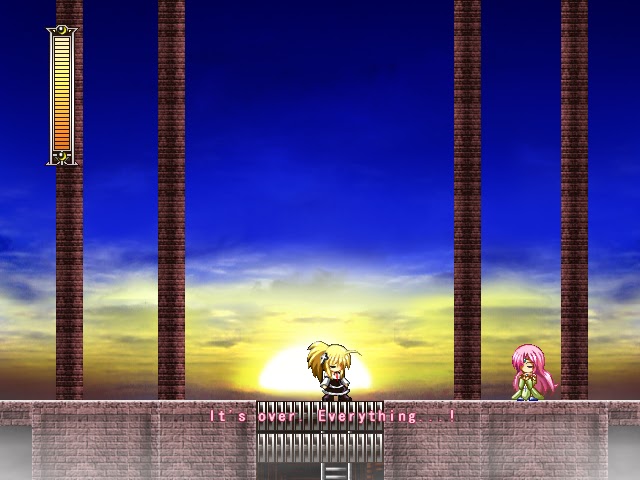
"Stay with me, Brother...!"
「お兄様、私を守って!」
(Iris, Megaman X4)
Yet another Megaman X4 reference. On one hand, the major characters of X4 all have their dialogue dubbed in English. On the other hand, their lines are somewhat over-localized: "Stay with me, Brother...!" doesn't mean the same thing as "Brother, protect me...!"... Given Liebea is thoroughly an embodiment of Iris's character -- a pacifist caught in the crossfire who just wants the ones she loves to stay safe -- we decided to go with the official localization, even if it's not 100% accurate.

"That was a magnificent battle...!"
「良い戦いだったぞ」
(Armored Armadillo, Maverick Hunter X)
Believe it or not, one of Seyfarth's victory cries is a reference to the Maverick Hunter X incarnation of Armored Armadillo. In Japanese, Seyfarth and Armadillo both follow the creed of the samurai. Unfortunately, this element of Armadillo's personality was lost in translation; in English, he comes across as stoic and stubborn instead of honor-bound and dutiful. In Maverick Hunter X, "Tatakai datta..." was rendered as, "It was a good fight..."; we revised the line to fit better with Seyfarth's battle-hungry personality.
I'm tempted to keep going and shine a spotlight on the remaining characters, but this post is already long enough as-is, and I need to make sure that at least a few of the references can still surprise you in the final release. We're regularly submitting debug builds to the publisher, so it's only a matter of time before the game is ready for release.
Well, that's all for now. See you next time!
Tuesday, January 19, 2016
RKS Developer Diary #9 - Head's Up!

This time around, we'll be looking at a couple of the visual references in Rosenkreuzstilette. One of RKS's claims to fame is its many sight gags, which pay homage to a number of old-school classics. As many of you already know, we're quite particular about styling sight gags just right to subtly reinforce the developer's intended nods.
Let's start by having a look at our favorite fiery redhead, Zorne Zeppelin. Zorne's fighting style is a direct homage to Hudson's Bomberman series, what with her old-fashioned cross-explosion fragmentation bombs and all. As much as I hate to admit it, her prosthetic arm is modeled after the character's redesign in Bomberman: Act Zero. I'd prefer to pretend the game never existed and credit that element of her design to the title character of the second Prince of Persia reboot, but I can't live in denial forever...
Zorne's character design aside, each of the Bomberman visual elements and mechanics in RKS is a reference to Super Bomberman 2 for the Super Nintendo Entertainment System. For example, once Zorne's vitality reaches 50%, a familiar warning message appears and blocks begin to fill the screen, leaving Spiritia and Zorne with only one minute to finish their fight before both of them are incapacitated -- just like Super Bomberman 2's Sudden Death mode, but with a slightly more forgiving time limit.

(...Why do I get the feeling someone is going to take the above statement out-of-context and misinterpret it as a personal attack of some kind...?)
Anyway, taking a cue from Bomberman's 2002 release on the Nintendo GameCube, we've updated the warning text to match the look of its counterpart in Super Bomberman 2 while using the higher-resolution font of Bomberman Generation. We followed this same train of thought with the Head's Up Display (HUD) for the secret area hidden in Zeppelin Stage IV. And the results? Well, they speak for themselves.

...In case anyone is wondering: yes, there are exactly 100 coins in this room, and collecting all of them does just what you would expect. So does letting the timer run down to 100 (or letting it expire completely), so don't dawdle!
Well, that's all for today. Thankfully, my new glasses are ready, so I can resume my usual pace now. I'm a bit surprised at how much extra programming work is needed to implement each individual subtitle for the voice clips in RKS (though, in all fairness, I shouldn't be). Because many of the voice clips play randomly, additional programming logic is required to catch which randomly-selected voice clip was chosen and display the corresponding subtitle before returning control to the game. The extra work in this department is a bit tedious and nowhere near as fun as the graphics work given its repetitive nature, but it's ultimately worth doing.
See you next time!
Wednesday, January 13, 2016
RKS Developer Diary #8 - Psst! What's the password?
 |
| This password works properly in the English version of the game. |
Today, we'll be looking at Rosenkreuzstilette's password system. Before we go over the changes we've made, it only makes sense to take a close look at how RKS's password scheme actually works.
As many of you have already noticed, RKS's password system is modeled after the password system from Megaman 4. In fact, until version 1.03a of RKS, the password schemes were identical. In Megaman 4, each password consists of six dots plotted on a six-by-six grid. Five of these dots each represent two specific items; the position each of these dots is placed in determines whether the player starts with one, both, or neither of the corresponding items. The position of the sixth dot records the total number of items. If the password contains less than six dots, if the values of any of the first five dots contradict one another, or if the value of the sixth dot does not match the actual number of items, the password is considered invalid.
Though RKS maps its values a little differently than Megaman 4, every single valid password that can be obtained in Megaman 4 works perfectly in RKS:
 |
| Note the placement of each of the boss characters in both games. |
| Dot 1 | Sichte Active (Toad Man Active) |
Die Geplante Zukunft (Rain Flush) |
| Grolla Active (Bright Man Active) |
A2 | B1 |
| Grollschwert (Flash Stopper) |
C2 | A1 |
| Dot 2 | Liebea Active (Drill Man Active) |
Liebessturm (Drill Bomb) |
| Luste Active (Pharaoh Man Active) |
A3 | C3 |
| Lustatem (Pharaoh Shot) |
B4 | A4 |
| Dot 3 | Schwer-Muta Active (Dust Man Active) |
Geisterwand (Dust Crusher) |
| Freudia Active (Ring Man Active) |
A5 | C5 |
| Freudenstachel (Ring Boomerang) |
B6 | B5 |
| Dot 4 | Trauare Active (Skull Man Active) |
Klageharnisch (Skull Barrier) |
| Zorne Active (Dive Man Active) |
D1 | F2 |
| Zornesbombe (Dive Missile) |
E1 | E2 |
| Dot 5 | No Lilli (No Wire) |
Lilli (Wire) |
| Story Mode (Balloon) |
D3 | F3 |
| Arcade Mode (No Balloon) |
E3 | D4 |
The sixth dot records how many items you have. To make things easier, I've color-coded the values; add 1 to your count for every dot mapped to a red coordinate, and add 2 to your count for every blue coordinate. The sixth dot should be mapped to the appropriate position:
 |
| These passwords only work with versions 1.03a through 1.06b of Rosenkreuzstilette. |
| Items | Position |
| 0 | F5 |
| 1 | A6 |
| 2 | B2 |
| 3 | B3 |
| 4 | C1 |
| 5 | C4 |
| 6 | C6 |
| 7 | D2 |
| 8 | E4 |
| 9 | E6 |
| 10 | F1 |
In version 1.03 of Rosenkreuzstilette, [erka:es] tweaked the password scheme a little so that players who had made it to the final stages (but were forced to end their play session prematurely) did not need to replay a quarter of the game just to be able to pick up where they left off. In order to start players beyond the Stage Select Screen, Isemiya capitalized on the fact that players were guaranteed to have at least 8 items before they could proceed to the castle or palace levels. Instead of mapping the sixth dot to E4, E6, or F1, players who had completed Zeppelin Stage IV received a new password with the sixth dot mapped to the following coordinates instead:
| Items | Position |
| 8 | D5 |
| 9 | E5 |
| 10 | D6 |
Of course, this password scheme, even in its expanded form, is not without its flaws. Since Megaman 4 only allowed players to start at the Stage Select Screen, passwords obtained during the game's opening stage are not recognized since they do not contain exactly six dots. Second, Megaman 4's password scheme uses 31 of the 36 dots to store 31 bits worth of information. The expanded password scheme adds just one bit of data, but occupies three more dots. Considering the game has a special value that records whether or not the player has reached the palace levels, this solution leaves plenty of room for improvement.
For the English release of RKS, the password algorithm has been expanded to recognize passwords for the Prologue stage (I won't count that as much of an accomplishment since the solution required very little additional code). The password scheme has been modified to allow for not just one, but four additional starting locations. I won't spill the beans on exactly what these starting points are -- many of you will discover them through normal gameplay, and the more ambitious among you can try and reverse-engineer the English password scheme in the same way I reverse-engineered the Japanese one.
Fun fact: I crack Megaman X passwords in my spare time as a mental exercise, to help me recognize patterns and help improve my programming skills. Did you know that you can enter a special password to start Megaman X with the Hadouken? Or that you can skip to any of the X-Hunter Stages in Megaman X2? How about equipping more than one enhancement chip at a time in Megaman X3?
Well, that's all for today. My new glasses are still in the shop; as you can imagine, my head is beginning to hurt from the eye strain. Next time, we'll have a look at a localization decision that I'm particularly proud of.
See you then!
Subscribe to:
Posts (Atom)